According to the Antigua and Barbuda Meteorological Services, moisture and instability associated with a frontal trough along with available low level patches will maintain a high chance for shower activity over and around the island during the next 24 hours. Possible rainfall total of up to 25.4MM or approximately 1 Inch is possible in some areas during that time.
Therefore, the weather tonight for Montserrat is expected to be mostly cloudy skies with periods of showers and a 40% or moderate chance of isolated thunderstorms.
Below, the rest of Tonight’s Local Weather Forecast for Montserrat- Friday, 4 February 2022:
Winds: East-northeast at 8 to 16 mph with lighter spells overnight..
Seas: 4 to 6 feet..
Sunrise tomorrow: 6:39 am.
Temperatures: nighttime highs to reach 29°C or 84°F.Remember, the weather can change at a moment’s notice, Stay Ahead! Events such as flash floods can occur with little or no warning due to prolonged rain, rain showers in higher elevations and soil saturation.
Weather Forecast: Antigua and Barbuda Meteorological Services Bernell Simon-Forecaster
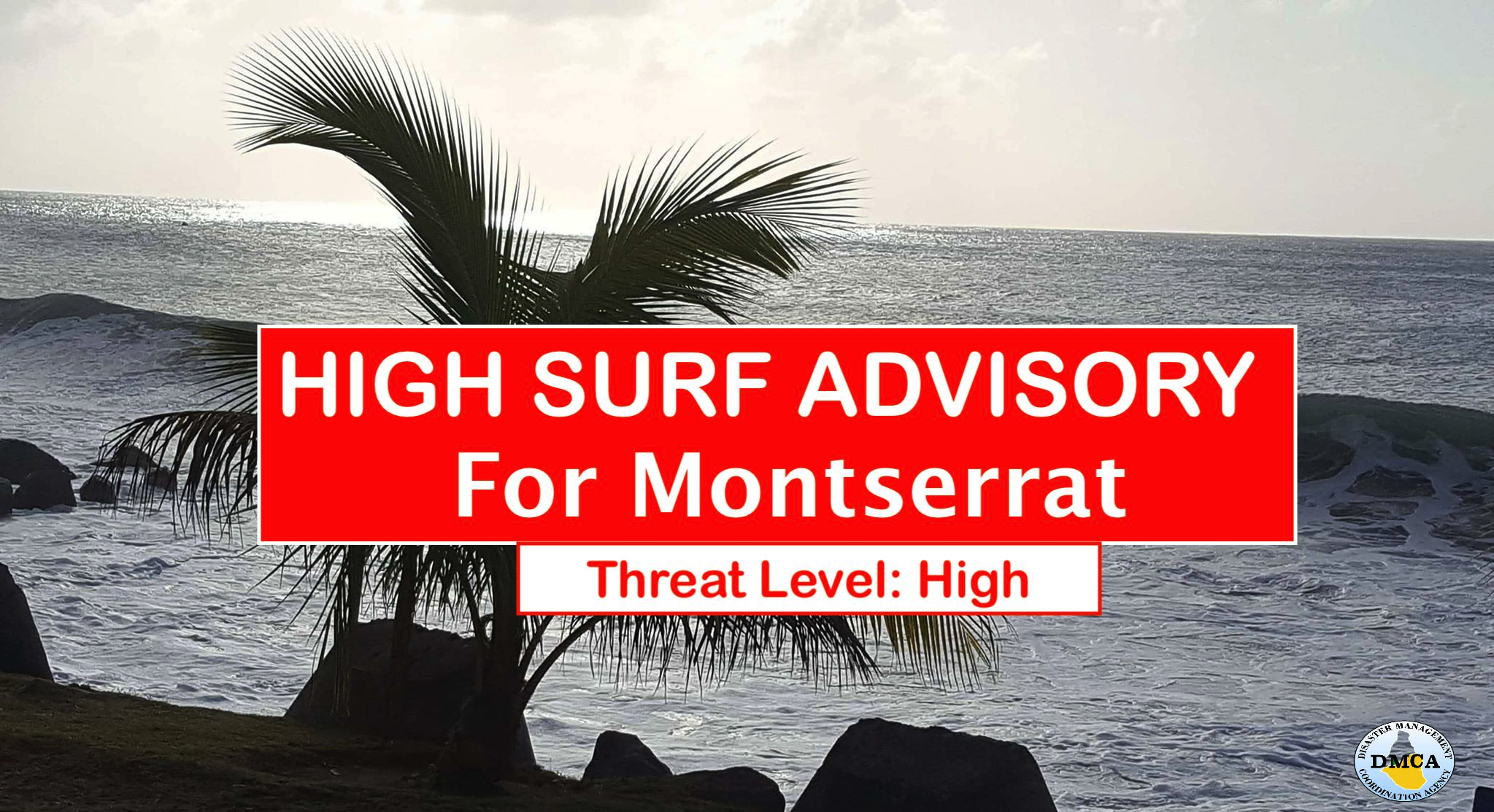
According to the High Surf Advisory issued for Montserrat, the locations to be affected are reefs and exposed mainly northern and eastern coastlines with relatively shallow, gently to moderately sloping, nearshore areas.
The affected coastlines are Marguerita Bay, Rendezvous Beach, Little Bay and Carrs Bay!
Beachgoers, especially to the mainly affected coastlines, should be extremely cautious; bathe only where lifeguards are present or the sheltered, less affected beaches, mainly to the south. Extreme caution is also required by those using the affected non-beach or rocky coastlines.
Timing: Friday late afternoon until Monday morning Montserrat.
Synopsis: Moderate long period swells are expected to reach the area and affect mainly northern and eastern coastlines. The threat level to the life, livelihood, property and infrastructure of those using the affected coastlines is forecast to rise to high, with the potential for extensive impacts. These swells are expected to cause life-threatening surfs and rip currents for affected coastlines. A high surf advisory means that dangerous surfs of 2 to 3 metres or 6 to 10 feet will affect some coastlines in the advisory area, producing hazardous conditions.
Seas (significant wave heights): 5 to 7 feet, occasionally or locally reaching 9 feet. Swell period: 9 to 14 seconds.
Swells: North-northeast at 5 to 7 feet and occasionally higher.Surfs (breaking swells): Over 6 feet. These conditions are conducive for dangerous rip currents. Please note that surfs could be as much as twice the height of swells, depending on the bathymetry of the nearshore areas.
Coastal flooding: High tides combined with onshore wind and swell actions could result in localized coastal flooding and beach erosion.
Potential Impacts: Loss of life–strong currents that can carry even the strongest swimmers out to sea; injuries to beachgoers; beach erosion; sea water splashing onto low lying coastal roads; beach closures; localized disruptions to marine recreation and businesses; financial losses; damage to coral reefs; saltwater intrusion and disruptions to potable water from desalination. High surfs can knock spectators off exposed rocks and jetties.
Rip currents are powerful channels of water flowing quickly away from shore, which occur most often at low spots or breaks in the sandbar and near structures such as groins, jetties and piers. If caught in a rip current, relax and float. Don`t swim against the current. If able, swim in a direction following the shoreline. If unable to escape, face the shore and call or wave for help.
Meteorologist Dale Destin for the Antigua and Barbuda Meteorological Service Climate Section said a cold front looks poised to cause a relatively very wet weekend across much of the northeast Caribbean, including Montserrat.
Destin stated that several reliable models are forecasting possible rainfall totals of 1 to 2 inches to fall over the period Friday, 4 February to Sunday, 6 February, 2022.
He said the potential total of 76 mm in 48 to 72 hours is not in and of itself a high figure. However, relative to February, this is a lot of water.
The Meteorologist postulated that the NOAA GFS model is indicating a 30-40% chance of more than 25 mm in 24 hours ending 8 am Saturday, 5 Feb, 2022. He added If the models prove right, this weekend would easily be the wettest in, at least, 16 weeks and the wettest month in four months.
Destin confirmed that the system has already caused wet weather across Hispaniola and Puerto Rico with isolated totals of up to 8 in. He further states that if this amount of rain was to reach Montserrat, it would cause absolutely wet conditions, but it is very unlikely that the island will get this lucky.
Source: Dale Destin, Meteorologist/Climatologist for the Antigua and Barbuda Meteorological Service Climate Section
The 2021 Atlantic Hurricane Season officially ends today, Tuesday, November 30, 2021.
However, we must remember that tropical systems can and do form in December as we saw in 2005 and 2007. On December 11th, 2007, Tropical Storm Olga formed and ultimately impacted the Greater Antilles.
The 2021 Atlantic Hurricane season will go down as the third most active, with 21 named storms, seven hurricanes, and four major hurricanes. That total is more than what was predicted by NOAA at the beginning of the season in May.
However, this year 21 storms were much less than 2020 with 30 named storms.There were four major hurricanes this season: Grace, Ida, Larry, and Sam. The strongest of them were Ida and Sam, which both reached Category 4 strength. Grace and Larry peaked as Category 3 storms.The strongest storm of the year was Hurricane Ida, with wind speeds of 150 mph at the end of August. The storm claimed the lives of at least 29 people across Louisiana and three in Mississippi, destroying businesses and neighbourhoods and knocking out power to hundreds of thousands.
Although, today marks the official last day of the 2021 Atlantic Hurricane Season, the Disaster Management Coordination Agency, DMCA is reminding residents that Montserrat is vulnerable to many other natural and man-made hazards such as earthquakes, extreme rainfall events, flash floods, landslides, fires, volcanic activities tsunamis and transportation accidents among many other events, therefore we must always be prepared for any emergency situation.
Additionally, residents must remain vigilant in fighting the coronavirus by continuing to practice good hygiene, wearing masks or face coverings and social distancing to prevent the virus from spreading.
The Antigua and Barbuda Meteorological Services issued the following High Surf Advisory for Montserrat:
Locations to be affected: Reefs and exposed mainly north to east-facing coastlines with relatively shallow, gently to moderately sloping near shore areas.
Timing: Monday night until Wednesday.
Synopsis: Moderate long period swells are forecast to reach the area and affect mainly north to east-facing coastlines. The threat level to the life, livelihood, property and infrastructure of those using the affected coastlines is expected to rise to moderate, with the potential for significant impacts. These swells are expected to cause life-threatening surfs and rip currents for affected coastlines.
A high surf advisory means that dangerous surfs of 2 to 3 metres or 6 to 10 feet will affect some coastlines in the advisory area, producing hazardous conditions.
Seas (significant wave heights): 2 to 2.7 metres (6 to 9 feet), occasionally or locally reaching near 3.5 metres (12 feet).
Swell period: 9 to 14 seconds. Swells: Northeast at 1.2 to 2 metres (4 to 7 feet) and occasionally higher.
Surfs (breaking swells): Over 2 metres (over 6 feet). These conditions are conducive for dangerous rip currents. Please note that surfs could be as much as twice the height of swells, depending on the bathymetry of the near shore areas.
Coastal flooding: High tides combine with onshore wind and swell actions could result in localized coastal flooding and beach erosion.Potential Impacts: Loss of life–strong currents that can carry even the strongest swimmers out to sea; injuries to beachgoers; beach erosion; sea water splashing onto low lying coastal roads; beach closures; localized disruptions to marine recreation and businesses; financial losses; damage to coral reefs; saltwater intrusion and disruptions to potable water from desalination. High surfs can knock spectators off exposed rocks and jetties.
Precautionary: Beachgoers should be extremely cautious; bathe only where lifeguards are present or the sheltered, less affected beaches, mainly to the south and west.
Rip currents are powerful channels of water flowing quickly away from shore, which occur most often at low spots or breaks in the sandbar and near structures such as groins, jetties and piers. If caught in a rip current, relax and float. Don`t swim against the current. If able, swim in a direction following the shoreline. If unable to escape, face the shore and call or wave for help.
That’s according to an Air Quality Bulletin, recently issued by the Antigua and Barbuda Meteorological Services.
It states that the air quality is down to moderate levels as a result of particulate matters 2.5 and 10, associated primarily with a fresh surge in Saharan Dust and that there’s high confidence that emissions from the volcano in La Palma, Canary Islands are also reaching the area; however, but the Dust dominates.
The Meteorological Agency has cautioned that the threat of health problems will become elevated for mainly unusually sensitive people, such as asthmatics and could potentially cause them limited impacts.
Air quality index: 50 to 80
Alert Level: II
Sensitive groups: People with respiratory or heart disease, the elderly and children are the groups most at risk.
Health implications: Air quality is acceptable; however, for some pollutants, there may be a moderate health concern for a very small number of people who are unusually sensitive to air pollution.
Caution: Active children and adults, and people with respiratory diseases, such as asthma, should limit prolonged outdoor exertion.
The Disaster Management Coordination Agency is urging residents with respiratory and heart diseases to have their medications on hand at all times, wear a mask when outdoors and keep windows and doors closed.
That’s according to a recently issued Air Quality Bulletin by the Antigua and Barbuda Meteorological Services.
It states that the air quality is down to moderate levels as a result of particulate matters 2.5 and 10, associated primarily with a fresh surge in Saharan Dust and that there’s high confidence that emissions from the volcano in La Palma, Canary Islands are also reaching the area; however, but the Dust dominates.
The Meteorological Agency has cautioned that the threat of health problems will become elevated for mainly unusually sensitive people, such as asthmatics and could potentially cause them limited impacts.
Air quality index: 60 to 90
Alert Level: II
Sensitive groups: People with respiratory or heart disease, the elderly and children are the groups most at risk.
Health implications: Air quality is acceptable; however, for some pollutants, there may be a moderate health concern for a very small number of people who are unusually sensitive to air pollution.
Caution: Active children and adults, and people with respiratory diseases, such as asthma, should limit prolonged outdoor exertion.
The Disaster Management Coordination Agency is urging residents with respiratory and heart diseases to have their medications on hand at all times, wear a mask when outdoors and keep windows and doors closed.
The Disaster Management Coordination Agency, DMCA urges active children and adults, and people with heart and respiratory and diseases, such as asthma to limit prolonged outdoor exertion, wear masks when outside and have their medications on hand.
Below, Today’s Weather Forecast for Montserrat – Friday, October 22, 2021:
Synopsis: Hazy and windy conditions continue across the Leeward Islands making for low chances for cloudiness and showers.
Weather Today: Partly cloudy and hazy with a 30% or low chance of showers.Winds: East, at 13 to 20 mph with possible higher gusts to near 30 mph.
Seas: 5 to 9 feet. The small craft advisory remains in effect.
Sunset today: 5:44 pm.
Weather Report: Antigua and Barbuda Meteorological ServicesOrvin Paige-Forecaster
That’s according to a recently issued Air Quality Bulletin, by the Antigua and Barbuda Meteorological Services.
It states that the air quality is down to moderate levels as a result of particulate matters 2.5 and 10, associated primarily with a fresh surge in Saharan Dust and that there’s high confidence that emissions from the volcano in La Palma, Canary Islands are also reaching the area; however, but the Dust dominates.
The Meteorological Agency has cautioned that the threat of health problems will become elevated for mainly unusually sensitive people, such as asthmatics and could potentially cause them limited impacts.
Air quality index: 60 to 90
Alert Level: II
Sensitive groups: People with respiratory or heart disease, the elderly and children are the groups most at risk.
Health implications: Air quality is acceptable; however, for some pollutants, there may be a moderate health concern for a very small number of people who are unusually sensitive to air pollution.
Caution: Active children and adults, and people with respiratory diseases, such as asthma, should limit prolonged outdoor exertion, wear masks when outdoors and have their medications on hand.